
Gnosticism radically reimagines the Abrahamic God, the creation he authored, and our relationship to both. Many Gnostic texts don’t see the God of Genesis as divine at all. He is a creature inhabiting our lower, material realm, often malicious or incompetent. The world he made is an abomination, and he inflicted a wound on the cosmos in fashioning it.
According to many Gnostic scriptures, the God of the Bible is a lower being of limited power. We should seek not to obey him, but to be liberated from him.
what is Gnosticism?
Gnosticism is complicated—really. From the documents we have, it is virtually impossible to define a single doctrine universally shared by all groups called “Gnostic.” The Gnostic scriptures are remnants of traditions that held to different cosmologies, pantheons, and practices.
Nonetheless, we can discern a certain flavor in these texts. And among the most popular of them, we find many shared ideas. With these reservations in mind, we can set forth a Gnostic worldview.
The term Gnostic derives from “gnosis,” the Greek word for “knowledge.” A Gnostic, then, is one who knows, and the knowledge they possess is of a very special character.
This gnosis is not for the masses, but only for the initiated. Upon receiving it, the knower understands the true nature of the world and their place in it, and is able to connect to a divine reality beyond (and superior to) the material universe.
It sounds pretty appealing until we dig into the character of this gnosis.
What Gnostics Believe about God
The God of the Bible, who spoke the world into being in Genesis, who found his creation good, is not the Gnostic god. Some Gnostics saw him as a short-sighted and ignorant creature, one who made a grave error in fashioning the universe. Others take a far less charitable view, calling him a wicked impostor.
In either case, the Abrahamic God would not be an omnipotent being outside of space and time, wholly other, not a thing among things. Instead, he would be a “demiurge,” a term that means “maker.”
The idea of a demiurge is not original to Gnosticism. Plato, for example, posits one in Timaeus, but his demiurge is good, and the demiurge of the Gnostics—while not outright evil in all Gnostic systems—is a being that, by his “making,” has caused a great deal of suffering.
origin story
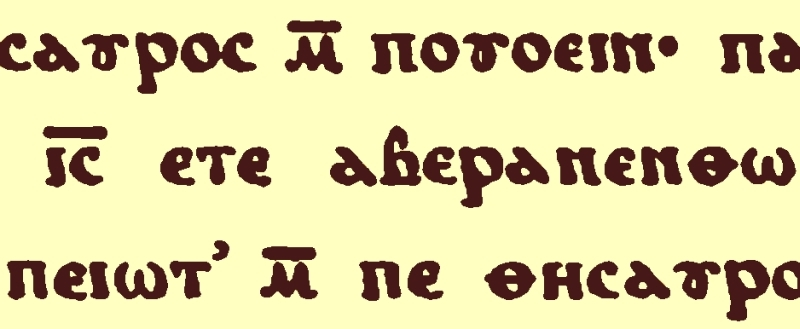
In The Apocryphon of John is one of the most famous (and best preserved) Gnostic texts. Its creation story harmonizes with those found in many similar works.
The highest god in The Apocryphon of John was quite busy before the formation of our world—a world that, recall, he didn’t author. We are told that he created deities with names like “foreknowledge,” “indestructibility,” “truth,” and other abstractions.
Sophia, a lower being, whose name means “wisdom” in Greek, made a terrible mistake. She “conceived a thought from herself and the conception of the invisible Spirit and foreknowledge. She wanted to bring forth a likeness out of herself without the consent of the Spirit,—he had not approved —and without her consort, and without his consideration. […Because] of the invincible power which is in her, her thought did not remain idle, and something came out of her which was imperfect and different from her appearance, because she had created it without her consort. And it was dissimilar to the likeness of its mother, for it has another form.”
So no intimate act occurred, Sophia apparently still conceived a “thought.”
It is said that all babies are beautiful, but the author of The Apocryphon of John would beg to differ. This creature warped “into a form of a lion-faced serpent” and had eyes like “lightning fires.”
Ashamed, she cast it “from her, outside that place, that no one of the immortal ones might see it.”
yaldabaoth
Sophia named this creature Yaldabaoth, and eventually took some pity on it. Since it was floating about in outer darkness, with no place to rest its behind, she gave him a “throne in the middle of a cloud” for a seat.
This creature, in its arrogance, proclaimed that it is the only god, and there is no other.
If such a statement sounds familiar, it is because the author of the Apocryphon of John is evoking Jewish scripture, asserting that Yaldabaoth is really Abraham’s God.
It is Yaldabaoth who fashions man from dirt, but, having no true power of his own, the creature is inert. Through a very complicated series of circumstances, it is Sophia’s breath that eventually animates our race.
So the God of the Bible, according to Gnostic teaching, is arrogant, myopic, and anything but divine.
conclusion
In the popular mind, Gnostic scriptures were hidden because they contain truths that the Church—in its hunger for control—deemed inconvenient to its plans of world domination. In reality, ancient Gnosticism survives in a diverse (and contradictory) body of writings that seek to dethrone the very God that Jesus and his disciples claimed to serve.
Gnosticism is right in asserting that creation is broken, but it is wrong to say that it is inherently so. The world, despite what The Apocryphon of John and texts like it claim, was made good. It is the Fall that corrupted our world, and human suffering issues from this momentous and tragic event.
There is much more to say about Gnosticism and the diabolical way that it inverts Christian orthodoxy. To get a full picture, we will need to understand The Gnostic view of Adam and Eve, and the Gnostic view of Jesus.