“The medium is the message.”
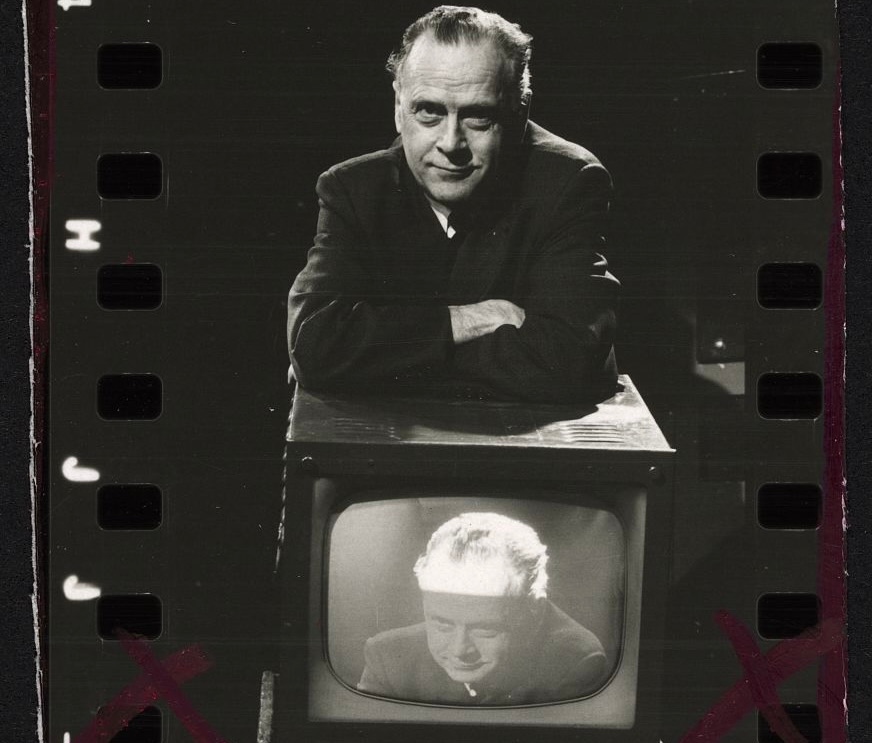
Marshall McLuhan’s words are as often repeated as they are misunderstood. He’s not talking about the power of an influential news program, a popular website, and so forth. No, what he’s saying is that media themselves—television, the internet, the printed word—speak to us and shape us far more profoundly than anything on television or the internet or in the paper.
So Marshall McLuhan, pioneering media theorist and cultural commentator, was proposing something very strange with these words.
Ezra Pound wrote, “Literature is news that stays news.” Hamlet may be centuries old, but the first time you encounter and understand it, when you reference it in a conversation with your friends, or you connect its story to current events, the great tragedy seems fresh. It’s “news.”
McLuhan’s saying remains news all these years later. It becomes, indeed, more relevant with each step in technological evolution.
So what does it mean?
In a culture like ours, long accustomed to splitting and dividing all things as a means of control, it is sometimes a bit of a shock to be reminded that, in operational and practical fact, the medium is the message. This is merely to say that the personal and social consequences of any medium—that is, of any extension of ourselves—result from the new scale that is introduced into our affairs by each extension of ourselves, or by any new technology.
Marshall McLuhan, Understanding Media: The Extensions of Man
These words open the first chapter of McLuhan’s most famous book. This is a dense passage, and at first glance it might seem to obfuscate things. But let’s unpack it:
Personal and social consequences
With the introduction of each new medium, our lives, both on an individual and a societal level, are altered. The electric light—one of McLuhan’s first examples, which he says “has no ‘content’”—had tremendous “personal and social consequences.” People could work at night more easily, streets could be illuminated in a way that made travel much safer (and thus more common) at all hours, and so forth.
The shape of the light, the wattage used, or its color may make a real difference if, say, you’re throwing an outdoor party at night. But these factors pale in comparison to how the medium itself, the electric light, has altered so much of how we interact with others and ourselves. The lights on my car and on the street allow me to see the road as I’m driving to your party. The power outlets to which you connect the lights you’re using for the party are built into your walls, changing the architecture of your home. If any of these factors were removed, there likely wouldn’t be a party at all.
Media as extensions of ourselves
Any extension, whether of skin, hand, or foot, affects the whole psychic and social complex.
Marshall McLuhan, Understanding Media: The Extensions of Man
For McLuhan, every medium, every technology, is an extension of some part of our body or mind. The wheel, he states, is an extension of the foot.
Of course it is. Thanks to the wheel, we were able to travel farther, and at speeds we could never dream of reaching on our own two legs. The social impact was enormous. The way roads were built and shaped changed, trade at long distances became possible, and warfare increased in scale and brutality.
Not all change is good. Some of it is catastrophic.
The Tube, Not the Show
By beginning with a medium without content, McLuhan shows us it’s not the particular light that matters, but the existence of electric lighting itself. This can be applied to media as we traditionally understand the term—to television, the internet, and so forth.
What is the “message” in such media? As we’ve seen, it’s not the particular show we’re watching, not the website we’re visiting or the app we’re using that is the true “message.” Of course, specific content might have a powerful effect. An influential political ad might sway enough voters to determine the next leader of the free world.
But it doesn’t compare to the fact that the ad was on television to begin with, that we’ve changed the design of our living rooms, our eating habits, out Saturday morning (cartoons) or Sunday activities (football) to accommodate the television. The more widely adopted a medium becomes, the more our lives are built around it.
That’s the true “message” of television. It says something about who we are in adopting it.
The smartphone has changed our posture to such a degree that text neck can “contribute to long-term degenerative changes in the spinal column, including damage to the spinal nerves and cervical disks.” That’s quite a message, but the smartphone as a medium has much more to say than that. To choose another of its many messages, it is reasonable to suspect that pornography use among smartphone users has changed the way men and women relate to one another, and perhaps impacted birth rates.
We are being whispered to incessantly by the media that have come to dominate our lives. The messages are mixed, both good and ill. We must listen carefully—for such discernment, grace is needed.